
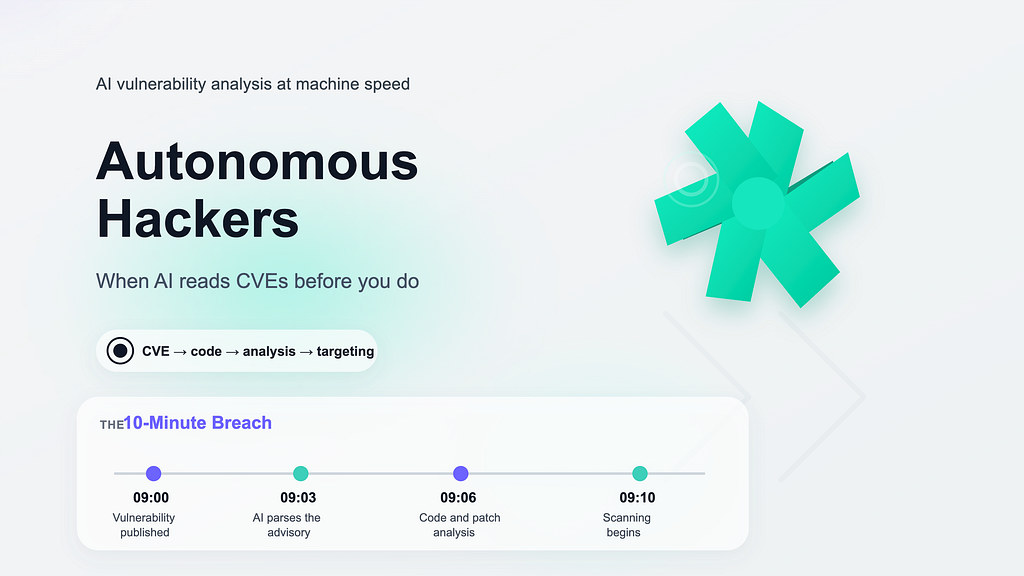
The 10-Minute Breach
At 09:00, a new vulnerability is published.
By 09:03, an AI system has parsed the technical details.
By 09:06, it has generated a working proof-of-concept exploit.
By 09:10, vulnerable servers across the internet are already being scanned.
No human wrote the exploit.
No human reviewed the advisory.
Welcome to the era of autonomous hackers
Understanding CVEs in Modern Cybersecurity
Every day, newly discovered software vulnerabilities are published through the CVE system — managed by MITRE Corporation — and then enriched in public databases like the National Vulnerability Database (NVD). These platforms allow security teams to quickly review severity scores, affected products, and technical references.
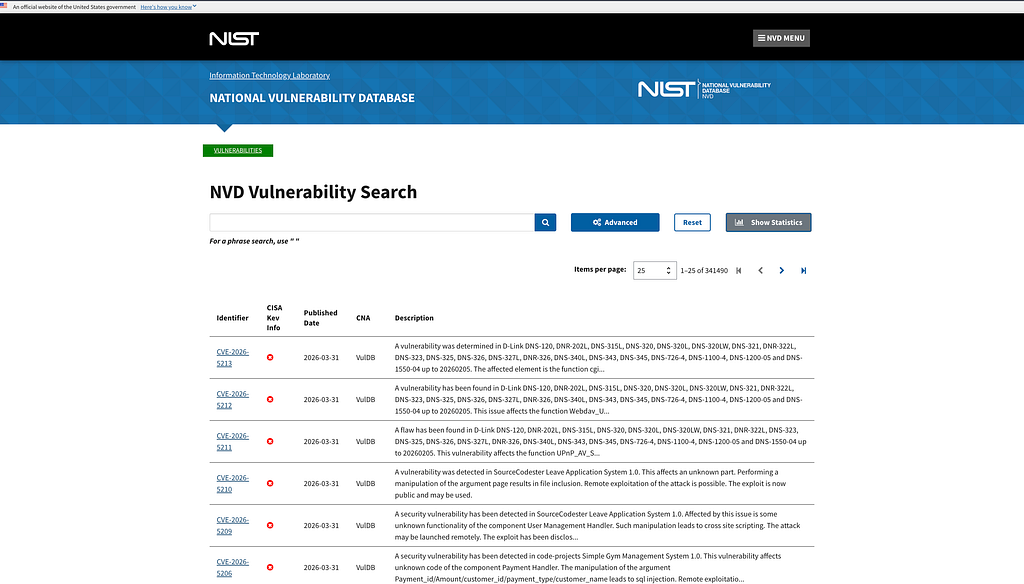
A typical CVE entry includes:
- A standardized vulnerability ID (e.g., CVE-2026-XXXX)
- A technical description of the flaw
- Affected software versions
- References to patches or advisories
Historically, CVEs provided a critical time advantage. Security teams could analyze the vulnerability, assess impact, and deploy patches before attackers could weaponize it.
That advantage is rapidly disappearing.
From AI Assistant to Exploit Engineer
Modern AI systems, developed by companies like OpenAI and Google DeepMind have evolved far beyond simple automation.
They can now:
- Interpret technical vulnerability descriptions
- Analyze source code repositories
- Generate functional scripts and payloads
- Test and refine outputs autonomously
This creates a powerful and dangerous pipeline:
Input: CVE description
Output: Working exploit code
No delays. No fatigue. Just execution at machine speed.
The Rise of Autonomous Exploitation
Let’s explore a realistic (hypothetical) scenario.
CVE-2024–34351
A real example from the modern web stack helps make this concrete.
CVE-2024–34351 is a high-severity server-side request forgery vulnerability in Next.js Server Actions. According to NVD and the GitHub advisory, it affected the next package from version 13.4.0 up to, but not including, 14.1.1, and under certain self-hosted conditions an attacker could manipulate the Host header to trigger requests that appeared to come from the Next.js application server itself.
Now imagine how an AI-assisted attacker would treat a disclosure like that.
First, the model parses the advisory and extracts the important signals: SSRF, Server Actions, Host header handling, affected versions, and the existence of a fix. Then it maps those details to public code, patch references, and implementation patterns in deployed applications. Next, it identifies the trust-boundary problem — server-side logic relying on request-derived data where it should rely on a trusted origin instead. From there, it can help generate safe validation checks, compare vulnerable and patched code, and prioritize internet-facing targets that may still be running affected versions. The exact workflow will differ from one actor to another, but the analysis phase itself becomes dramatically faster.
That is the real shift. The threat is not only the vulnerability. It is the shrinking gap between publication and operational understanding.
Example: A Safer Code Pattern
Instead of showing exploit code, a smarter choice for a public article is to show the kind of defensive logic a reviewer should look for. In a case like CVE-2024–34351, the key question is whether server-side redirects or requests rely on trusted configuration — or on user-influenced request data. The issue was fixed in Next.js 14.1.1.
// Simplified defensive example for review only
export async function serverAction(req: Request) {
 const trustedBase = new URL(process.env.APP_ORIGIN || "https://example.com");
 const path = "/dashboard";
 // Build redirects from a trusted origin,
 // not from request-derived host values.
 const safeUrl = new URL(path, trustedBase);
 return Response.redirect(safeUrl.toString(), 302);
}
This is where automation becomes dangerous in practice. An AI system does not need to “be a hacker” in the cinematic sense. It only needs to accelerate code review, compare vulnerable and fixed patterns, and surface likely mistakes at machine speed.
The Collapse of the Patch Window
Traditionally, the vulnerability lifecycle looked like this:

This gave defenders time — sometimes days or weeks.
Today, we are witnessing the emergence of:
Zero-Time-to-Weaponization (ZTW)

Security teams are no longer racing attackers.
They are racing algorithms.
AI vs AI: The New Cybersecurity Arms Race
Defenders are not standing still. They are already using AI to review code, detect anomalies, triage alerts, and speed up remediation. The same model capabilities that can help a developer understand a patch can also help a security team understand exposure.
But there is a hard asymmetry at the center of cybersecurity that AI does not erase.
Attackers need one opening.
Defenders need broad, consistent coverage.
That imbalance matters. Even if defensive teams adopt AI successfully, they still have to deal with legacy systems, weak asset visibility, slow patch cycles, and incomplete inventories. A fast model is useful. A fast model plus poor operational hygiene is not enough.
Real-World Warning Signs
The warning signs are already here. Publicly known vulnerabilities remain common enough in active operations that CISA continuously updates its Known Exploited Vulnerabilities catalog, and long-standing threat research has shown that exploitation often follows disclosure or patch release very quickly.
That does not mean every CVE becomes an instant global crisis. Most do not. But it does mean defenders should stop thinking of disclosure as the beginning of a leisurely review cycle. In many cases, disclosure is the starting gun.
Ethical and Strategic Implications
This raises uncomfortable questions.
Should CVE records become less detailed to slow down attackers? Or would that mostly hurt defenders, who depend on transparency to assess exposure? Should AI systems be more tightly restricted when asked to analyze vulnerabilities? And if a model helps compress the path from advisory to attack, where does responsibility actually sit — with the model provider, the operator, the user, or the ecosystem that made the information public in the first place?
There are no simple answers here. Only trade-offs between openness, safety, research, and operational reality.
The Future of Cybersecurity: Machine vs Machine
We are moving into a world where machines increasingly assist at every stage of the security lifecycle. They can help find vulnerabilities, explain code, compare patches, generate tests, and support defensive monitoring. That same acceleration can benefit defenders or attackers depending on who moves first.
Humans are not disappearing from cybersecurity. But they are being pushed up a level. Less manual parsing. More oversight, policy, prioritization, and response. The people who win in this environment will not be the ones who ignore AI. They will be the ones who learn how to govern it.
Final Thoughts
- Cybersecurity used to be a battle of skill.
- Then it became a battle of scale.
- Now it is becoming a battle of speed.
And in that race, AI does not merely move faster than humans. It changes the shape of the contest itself. The most important question is no longer whether a published vulnerability will attract attention. It is how quickly that attention can be converted into action.
That is why the age of autonomous hackers matters. Not because every model is an attacker. But because every public weakness is now readable, sortable, and actionable by systems that never sleep.